I use an KVM virtualized server since almost years. After the last update of my 9.7 I immediately get a kernel panic after boot. I tried an original ISO, I tried previous kernels, … no luck. I cannot get the system to run again.
What boots is for example an Ubuntu live system and also Fedora runs but no Alma anymore. What can you recommend on what to do next? I want to have the system running again, even on a new version or different distribution if that is somehow possible.
I heard already, that this has something to do with v3 and v2 but also no luck with v2.
RHEL 9 / CentOS Stream 9 requires the x86-64-v2 CPU baseline, and Red Hat notes that guests may fail to boot with QEMU’s default “qemu64” or “kvm64” CPU models.
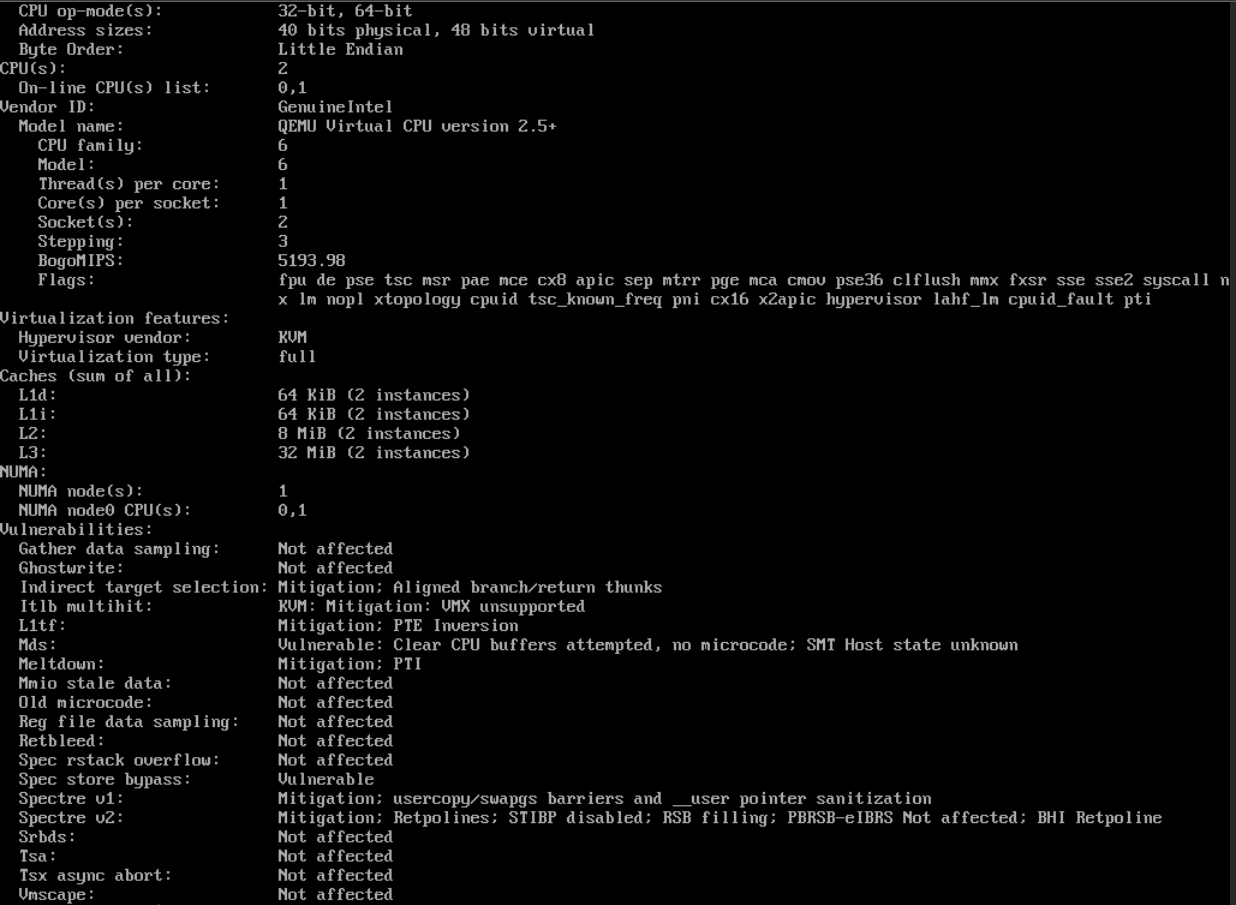
From your Fedora lscpu output, the guest is seeing “QEMU Virtual CPU version 2.5”.
That usually means the VM is using an old/generic CPU model, and required x86-64-v2 CPU features may be hidden.
Please change the VM CPU type on the KVM host to one of these:
host-passthrough
host-model
x86-64-v2 / x86-64-v2-AES
Then try booting the installed AlmaLinux system again.
This is also why older kernels may not help: the problem may be the virtual CPU model, not the disk or a specific kernel package.
host-paththrough, E1000 network and IDE harddrive at least lets the rescue of 10.1 boot (unfortunately there is no 9.7 v2 version). I hope I can get it to run now. Thanks a lot!